
Appliance PCB Or Circuit Boards: Repair or Replace?
Independent multi brand repair service. We are not an authorised service centre for any brand and we are not associated with any manufacturer. Full disclaimer at the end of this page.
When a control board fails, most repairers fit a new one. That is faster and easier than finding the actual fault on it. In practice a good share of boards can be repaired at component level instead, and a repair typically costs around half what a replacement does. Here is what actually fails on these boards, which faults are worth repairing, and when a new board really is the right answer.
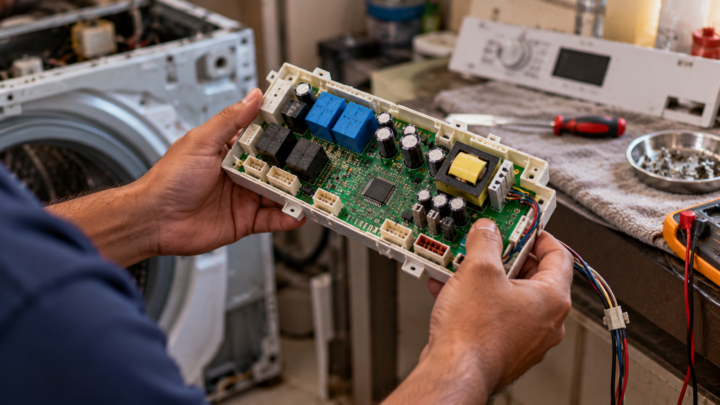
What the board actually does
The printed circuit board, usually called the PCB, is the part that runs everything else. It reads the sensors, decides what should happen next, and switches power to the motor, the valves, the pump and the heater at the right moments. On a modern washing machine or microwave it is doing most of the thinking.
Because it touches everything, a board fault can look like almost any other fault. A machine that will not spin, a fridge that will not start its compressor, a microwave with a dead panel. This is also why boards get blamed for problems they did not cause, which is worth keeping in mind when someone quotes you for one.
What actually fails on a control board
Boards rarely fail as a whole. The failure is almost always in one of a small number of components, and that is the reason repair is possible at all.
- Relays. Small switches that handle high current. Their internal contacts burn and pit over thousands of operations until they stop making a clean connection. One of the most common failures and one of the most repairable.
- Capacitors. They dry out and lose capacity with age and heat. A bulging or leaking capacitor is often visible to the eye once the board is out.
- Burnt tracks. The copper paths on the board itself can overheat and break, usually around a component that was drawing too much current. These can be bridged and rebuilt.
- Dry or cracked solder joints. Years of vibration and heat cycling crack the solder around heavier components. A machine with an intermittent fault that comes and goes is often this.
- Triacs and power transistors. The components that switch the motor and heater. They fail from surges and from the heat of normal work.
- Surge damage. A voltage spike can take out the input section while leaving the rest of the board perfectly healthy.
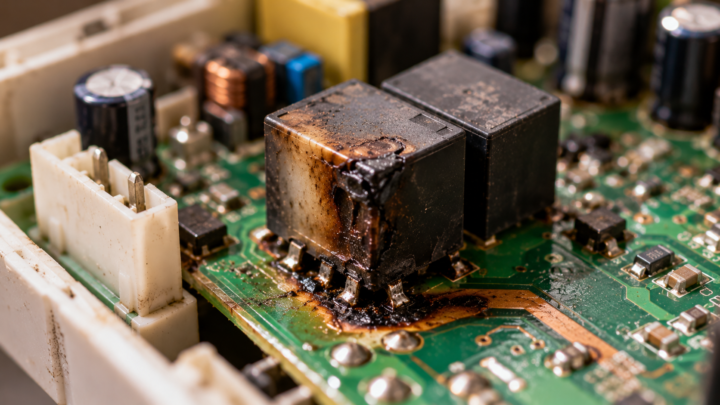
Repair against replacement
Swapping a board is quick. Pull the old one, fit the new one, test, leave. It takes less skill, less time and less equipment, and it carries a bigger parts bill. That is why it is the default almost everywhere.
Repairing one means getting the board on a bench, finding which component has failed, replacing just that component, and testing the board under load before it goes back in. It takes longer and it needs someone who can work at that level. The part cost is a fraction of a new board, so the customer pays appreciably less, usually in the region of half.
We work the other way round from the industry default. A board comes out, goes on the bench, and gets tested before anyone talks about replacing it. Across the board work we do, the large majority are repaired rather than swapped.
Worth knowing: a repaired board is not a temporary fix. Replacing a failed relay with a new relay of the correct rating puts that part back to new condition. We stand behind repaired boards the same way we stand behind replaced ones, and in some cases the warranty on a board repair runs longer than the standard 30 days. The technician will tell you what applies to your job.
When a board cannot be saved
Sometimes replacement is the honest answer, and these are the cases.
- Severe burn damage across a large area, where the board material itself is charred rather than just a track.
- A failed microcontroller carrying the manufacturer's firmware. That chip cannot be sourced and programmed independently.
- Water damage with corrosion spread across the board. Corrosion keeps working after the board dries out.
- Multiple separate failures on an old board, where fixing three things today is likely to be followed by a fourth next month.
When we find one of these, we say so. There is no value in selling a repair that will not hold.
Before you pay for a board at all
This is the part worth being alert to. A board is one of the more expensive parts on most appliances, and it is also the easiest thing to blame when a diagnosis has not been done properly.
A machine that will not spin is far more often a lid switch, a belt or carbon brushes than a board. A fridge that will not cool is far more often a start relay, a sensor or a defrost fault. A microwave with no heat is far more often the magnetron. If someone quotes you for a board without having tested the simpler parts first, it is reasonable to ask what they ruled out and how.
A genuine board fault usually announces itself differently: a completely dead panel, buttons that do nothing, a display showing nonsense, or a machine behaving in a way that makes no mechanical sense at all.
Roughly what it costs
The doorstep visit and full diagnosis is a flat ₹299, set against your final bill if you go ahead. Beyond that, the useful number is the comparison rather than a figure: a board repair typically comes to around half what a replacement board costs for the same machine, sometimes less.
Some board work can be finished in the home. Some needs the board taken to the workshop, tested properly and refitted on a second visit, and the technician will tell you which applies before anything is removed.
What a repair costs depends on the fault, the parts used, the brand and the condition of the machine, so we quote only after the technician has seen it, and nothing proceeds without your approval.
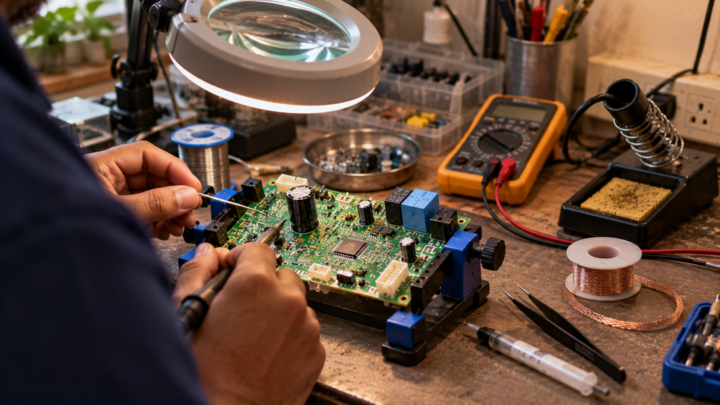
Why boards fail here
Voltage instability is the main driver. Spikes and sags stress the input section of every board in the house. It is the single biggest reason we see board failures, and it is also the most preventable.
A stabiliser is cheap insurance. For any appliance with a board worth protecting, and that is most of them now, a stabiliser rated for the machine costs a fraction of what a board does. On a line that also runs air conditioners in summer, it is worth doing.
Humidity works slowly. Damp air over years encourages corrosion on solder joints, particularly on appliances kept in a poorly ventilated corner or a covered balcony.
Power cuts and hard restarts. Every sudden loss and return of supply is a small shock to the board. Buildings with frequent interruptions go through boards faster, which is worth knowing when weighing up a stabiliser.
Questions people ask us
Can an appliance circuit board actually be repaired?
In many cases yes. Boards rarely fail as a whole. The fault is usually one component: a burnt relay, a dried out capacitor, a cracked solder joint or a damaged track. Replacing that single component restores the board. It takes a bench, test equipment and someone able to work at component level, which is why most repairers skip it and fit a new board instead.
Is a repaired board as reliable as a new one?
For a single component failure, yes. Fitting a new relay of the correct rating puts that part back to new condition, and the rest of the board was never faulty. Where a board has widespread burn damage, water corrosion or several separate failures, repair is not the right answer and we will tell you that rather than patch it.
How much does appliance PCB repair cost in Kolkata?
The doorstep visit and full diagnosis is a flat ₹299, set against your final bill if you go ahead. As a rule of thumb a board repair comes to around half what a replacement board costs for the same machine. What a repair costs depends on the fault, the parts used, the brand and the condition of the machine, so we quote only after the technician has seen it, and nothing proceeds without your approval.
Do you repair control boards across Kolkata?
Yes, on washing machines, refrigerators and microwave ovens from every major brand, as an independent multi brand repair service. Some board work is done in the home and some needs the board brought to our Birati workshop and refitted on a second visit. We cover Birati, Dum Dum, Madhyamgram, Sodepur and the surrounding North Kolkata areas. Every repair carries our 30 day repair warranty, and board work often carries longer cover depending on the job.
Been quoted for a new control board?
Worth a second opinion before you pay for one. A technician visit is a flat ₹299 including full diagnosis, and we test the board before anyone talks about replacing it.
Independent multi brand repairs Based in Birati, North Kolkata 30 day repair warranty
Important: we are an independent repair service
Roy Home Appliances Service Care is an independent, third party home appliance repair service provider. We are not an authorised service centre for any brand, and we are not associated with, affiliated to, endorsed by or part of the authorised service network of any brand or any other brand or manufacturer.
We are a multi brand repair service. We repair home appliances from all major brands, and we have no commercial tie up with any single one of them. Brand names, model names and product names mentioned on this page are the property of their respective owners and are used here only to identify the appliances we service and to help readers understand their own machine.
If your appliance is still inside the manufacturer's warranty period, we would suggest you contact the brand's own authorised service centre first, since a repair by an independent service provider may affect that warranty.
