
Samsung Washing Machine Error Codes Explained (And Which Ones Need a Technician)
Independent multi brand repair service. We are not an authorised Samsung service centre and we are not associated with Samsung or any other brand. Full disclaimer at the end of this page.
Samsung washing machines flash a short code on the panel when something stops a cycle. Nearly all of them point at one of three things: water coming in, water going out, or the door. Plenty of them clear once the real problem is sorted, without any parts at all. Below is what each code actually means, what we usually find when we attend, and the point where you should stop and call someone.
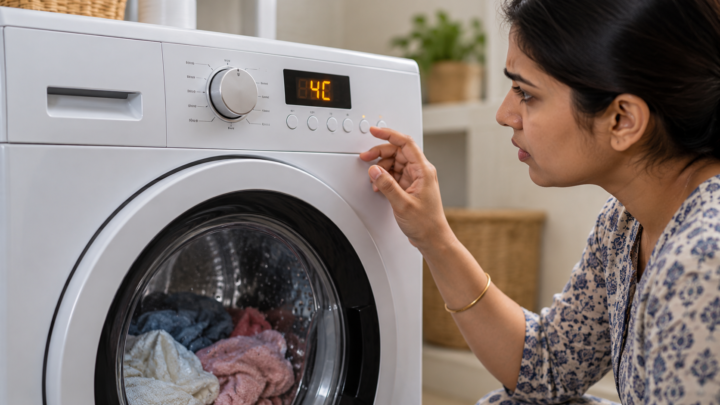
Samsung washing machine error codes at a glance
| Code | What it means | Usual cause | Can you sort it? |
|---|---|---|---|
| 4C | Machine is not getting enough water | Tap half closed, kinked inlet hose, clogged inlet filter, low building pressure | Usually yes |
| 4C2 | Hot water feeding the cold inlet | Hoses connected the wrong way round at installation | Usually yes |
| 4E | Water supply fault on older models | Same family of causes as 4C | Usually yes |
| 5C | Water is not draining out | Blocked drain hose, choked pump filter, jammed drain pump | Check the filter first |
| 5E | Drain fault on older models | Same family of causes as 5C | Check the filter first |
| DC | Door or lid is not shut properly | Laundry caught in the opening, worn latch, failing lock switch | Check, then call |
| DC1 | Door lock fault on front loaders | Failed door lock assembly | Call a technician |
| UB / UE | Load is unbalanced | Wet laundry bunched to one side of the drum | Usually yes |
| UC | Supply voltage outside the safe range | Voltage fluctuation, weak house wiring, extension board overloaded | Partly |
| 1C | Water level sensor fault | Failed pressure sensor or a blocked air trap hose | Call a technician |
| 3C | Motor fault | Drive motor or its position sensor | Call a technician |
| LC / LE | Water is leaking | Loose hose joint, perished seal, cracked tub | Call a technician |
| OC / OF | Overflow | Stuck inlet valve or a faulty water level sensor | Call a technician |
| tE | Temperature sensor fault | Thermistor on the heater assembly | Call a technician |
| HE | Heater fault | Heating element or its thermostat | Call a technician |
| E1 | Fill problem on older E series machines | Same family of causes as 4C | Usually yes |
| E2 | Drain problem on older E series machines | Same family of causes as 5C | Check the filter first |
Samsung changed its code system around a decade ago. Older machines show an E series code (E1, E2, E3) while newer ones show a letter with a C (4C, 5C, DC). Both sets are in the table above. If your panel shows something that is not listed, note it down exactly as it appears, including whether it is a letter or a number, and check the sticker inside the door or behind the lid.
4C: the code we get called about most
Four out of five times, a 4C has nothing wrong with the machine at all. The control board has waited for the drum to reach a water level, not seen it happen within the time allowed, and stopped the cycle to avoid running dry. So the question is not what broke, it is what is slowing the water down.
Work through these in order before calling anyone:
- Check the tap is fully open. Half open is enough for a bucket and not enough for a washing machine. This is the single most common cause we find.
- Look along the inlet hose for a kink. Machines get pushed back against the wall after cleaning and the hose folds behind them.
- Clean the inlet filter. Turn the tap off, unscrew the hose at the back of the machine, and you will see a small mesh filter sitting in the inlet. In most Kolkata homes it is grey with sediment. Rinse it, refit it, hand tighten.
- Try it at a quieter hour. If your building runs on a pump and the supply drops in the morning rush, the machine may fill properly at 11am and throw 4C at 7am.
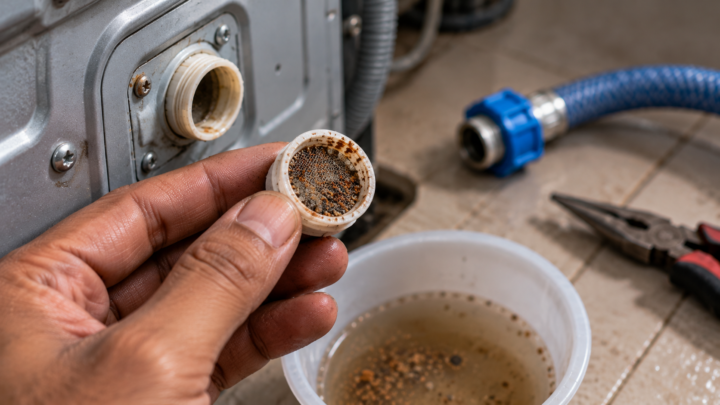
If all four checks are clear and the code still shows, the inlet valve itself has most likely failed. That is a part replacement and it is one of the more affordable repairs on a washing machine. Our technician tests the valve on site and tells you before anything is opened up.
5C and 5E: water sitting in the drum
The cycle runs, then stops with the drum still full. The machine is not able to push the water out. Start with the pump filter, because that is where the problem usually is.
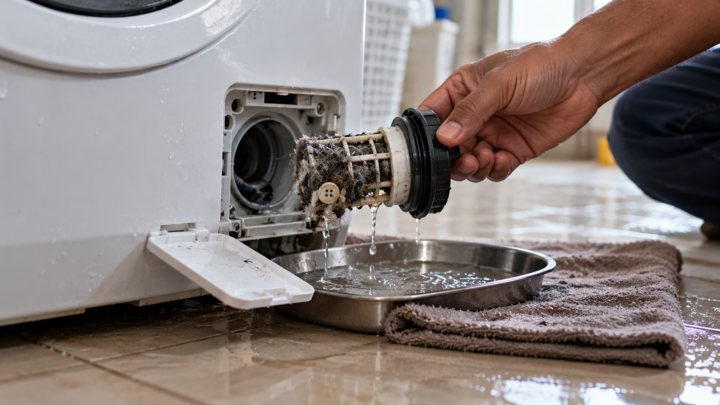
On most Samsung front loaders there is a small hatch at the bottom right of the front panel. Behind it is a filter and a short drain tube. Put an old towel and a flat tray down first, because what comes out is more water than people expect. Unscrew the filter and look at what is in it. Coins, hair clips, lint and the occasional safety pin account for the bulk of what we pull out.
Then check the drain hose at the back. If it is pushed too far down into the drain pipe, or it has a dip holding water, the machine cannot clear the line. The outlet end should sit at the height the manual specifies, not lie flat on the floor.
If the filter is clean and the hose is clear, the pump is probably jammed or burnt out. On a jammed pump you can often hear it trying to run, a low hum with nothing moving. That one needs opening up.
DC: the door code
A DC means the machine does not believe the door is shut. Usually it is right. A sleeve, a corner of a bedsheet or a sock caught in the seal is enough to keep the latch from seating. Open it, redistribute the load, press the door firmly until you hear it click, and start again.
When the door is genuinely closed and DC still appears, the latch or the lock switch has worn. On top loaders the equivalent part is the lid switch, which is a safety cut off that stops the drum spinning with the lid up. It is a small part and one of the cheaper faults on the machine, which is worth knowing because a machine that fills and washes but refuses to spin often has people fearing the worst.
UC: the one that is really about your power supply
UC is not a fault in the machine. It is the machine telling you the voltage reaching it is outside the range it is built to tolerate, and that it has shut down rather than risk its own electronics.
This matters in Kolkata more than it would elsewhere. Supply here swings, particularly in summer evenings and in older buildings where the wiring was never sized for four air conditioners and a washing machine running together. A few things help:
- Plug the machine straight into a wall socket. Extension boards and multi plugs shared with other appliances are a common cause.
- Check whether the code appears at a particular time of day. If it does, that points at the supply rather than the machine.
- If UC comes up regularly, a voltage stabiliser rated for the machine is worth the money. It costs considerably less than a control board.
Worth knowing: repeated voltage swings are one of the main reasons control boards fail on washing machines in this city. A machine that keeps throwing UC and gets ignored often turns into a board fault a few months later, and that is a far bigger repair than a stabiliser.
When a code means stop using the machine
Unplug the machine and call someone if you see any of these.
LC or LE, a leak code. Water and a live appliance do not belong together. Turn it off at the socket, close the tap, and leave it.
Any burning or hot plastic smell, with or without a code on the panel.
The machine trips your MCB or RCCB when you switch it on. That is an electrical fault, not a cycle fault.
3C, a motor code, that returns after a reset. Running a machine with a failing motor can take the control board with it.
One general rule: do not keep resetting and restarting a machine that shows the same code each time. The code is doing its job. Clearing it repeatedly only removes the warning, and in a few cases it turns a single part failure into two.
Why these codes come up more often in Kolkata
Having worked on machines across North and Central Kolkata for over twelve years, a few local patterns are hard to miss.
Water pressure is behind a good share of 4C calls, especially on upper floors of older buildings and in flats fed by a shared pump. Nothing is wrong with the machine. It simply cannot fill fast enough during peak hours.
Sediment blocks inlet filters here faster than the manuals assume. Cleaning that filter once or twice a year prevents a service call.
Voltage swings drive UC codes, and over time they are the leading cause of the control board failures we repair.
Monsoon damp works on door seals and rubber gaskets. A door that seals perfectly in February can start throwing DC codes in August as the gasket swells and stiffens.
Questions people ask us
How do I reset a Samsung washing machine error code?
Switch the machine off at the socket, wait about a minute, then switch it back on and start a short cycle. That clears the code from the display. What it does not do is fix whatever triggered it. If the code comes straight back, the underlying problem is still there and resetting again will not help.
Does an error code mean the control board has gone?
Very rarely. Most codes point at water supply, drainage, the door or an unbalanced load, and plenty of them need no parts at all. A genuine board fault shows up differently: a dead panel, frozen buttons, or a code that makes no sense against what the machine is actually doing. Even then, a board can often be repaired at component level rather than replaced outright, which costs significantly less.
What does it cost to fix a Samsung washing machine error?
The doorstep visit and full diagnosis is a flat ₹299, and that amount is set against your final bill if you go ahead with the repair. The repair itself varies a great deal: a clogged filter or a misrouted drain hose may need nothing beyond the visit, while an inlet valve, a drain pump or a door lock is a modest part replacement, and motor or board work sits higher. What a repair costs depends on the fault, the parts used, the brand and the condition of the machine, so we quote only after the technician has seen it, and nothing proceeds without your approval.
Do you repair Samsung washing machines across Kolkata?
Yes. We work on Samsung top load, front load, semi automatic and fully automatic machines, along with every other major brand, as an independent multi brand repair service. Our workshop is on Nilachal Road in Birati, so we reach Birati, Dum Dum, Madhyamgram, Sodepur and the surrounding North Kolkata areas quickly, usually the same day. Every repair carries our 30 day repair warranty, and replaced parts often carry longer cover depending on the part.
Code still showing after the checks?
Tell us the code and the model and we will say what it is likely to be before anyone travels. A technician visit is a flat ₹299 including full diagnosis.
Independent multi brand repairs Based in Birati, North Kolkata 30 day repair warranty
Important: we are an independent repair service
Roy Home Appliances Service Care is an independent, third party home appliance repair service provider. We are not an authorised service centre for Samsung, and we are not associated with, affiliated to, endorsed by or part of the authorised service network of Samsung or any other brand or manufacturer.
We are a multi brand repair service. We repair home appliances from all major brands, and we have no commercial tie up with any single one of them. Brand names, model names, product names and error codes mentioned on this page are the property of their respective owners and are used here only to identify the appliances we service and to help readers understand their own machine.
If your appliance is still inside the manufacturer's warranty period, we would suggest you contact the brand's own authorised service centre first, since a repair by an independent service provider may affect that warranty. Error codes also vary between models and production years, so treat this guide as a starting point rather than a replacement for your own machine's manual.
