
Fridge Not Cooling But the Light Is On? Here Is What We Usually Find
Independent multi brand repair service. We are not an authorised service centre for any brand and we are not associated with any manufacturer. Full disclaimer at the end of this page.
A fridge with a working light has power. That rules out the fuse, the plug and the socket straight away, and it moves the search to the cooling side: airflow, the defrost system, the sensors, the start relay, the compressor and finally the gas. Here is the order we actually check them in, which ones you can look at yourself, and the point where it stops being a home job.
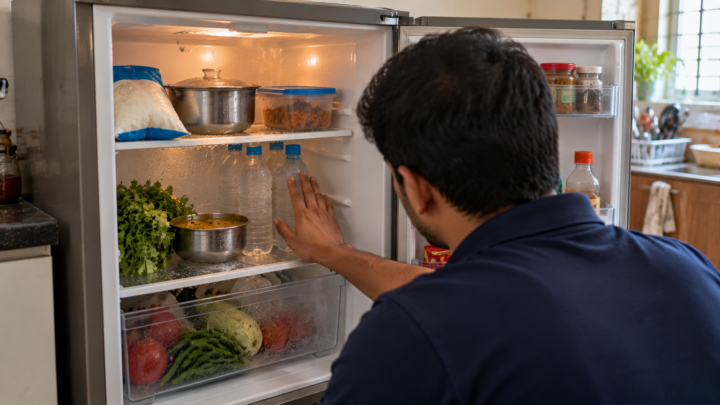
The causes, in the order we check them
There is a reason technicians work in a fixed order. The cheap, common causes sit at the top, and every one you rule out narrows the next step. Working backwards from the compressor is how people end up paying for a part they never needed.
- Thermostat setting and overloading. A knob nudged to minimum while cleaning, or a fridge packed so full that air cannot move around the shelves. Both look like a cooling failure.
- Door seal. A perished or distorted gasket lets warm air in continuously. The fridge runs and runs and never gets there.
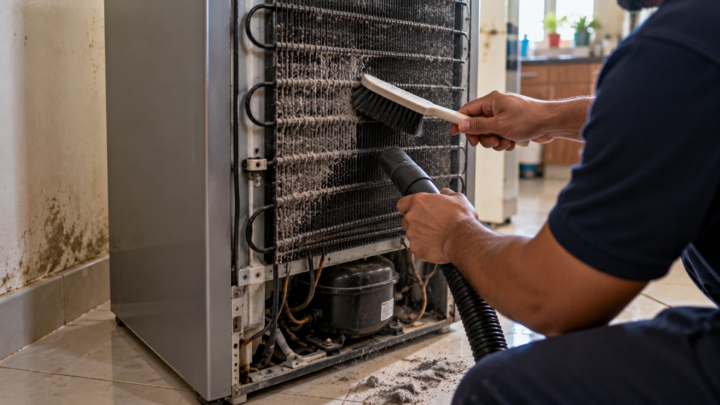
- Dusty condenser coils. The black grid at the back. Caked in dust it cannot shed heat, so cooling drops off even though everything is working.
- Condenser fan. On fridges that have one, a seized fan means heat stays in the system.
- Frost on the evaporator. A defrost fault leaves a block of ice behind the back wall of the freezer, and that blocks the cold air path to the fridge section.
- Sensor or thermostat failure. The fridge is simply not being told to cool.
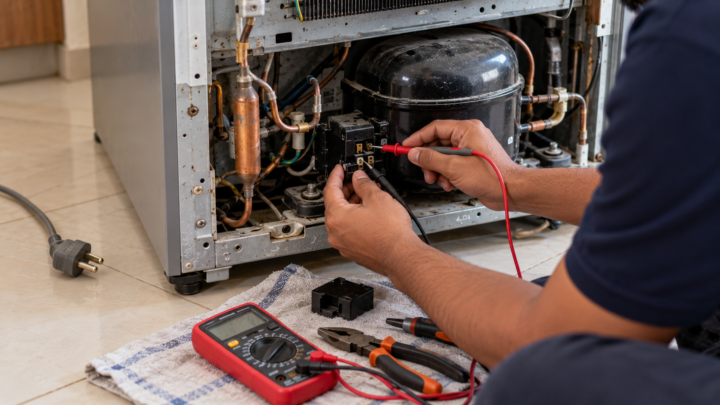
- Start relay and overload protector. The small part on the side of the compressor. It fails more often than the compressor does.
- Compressor. Running but not pumping, or not starting at all.
- Refrigerant leak. Last on the list, not first.
Worth knowing: a lot of people assume a fridge that is not cooling needs gas. In practice gas sits near the bottom of this list. A sealed system does not consume refrigerant, so if it is genuinely low there is a leak somewhere, and refilling without finding that leak just buys you a few months.
What you can safely check yourself
All of these are no tools, no risk, ten minutes.
- The thermostat dial or digital setting. Make sure it has not been knocked to its lowest position.
- The door seal. Close the door on a sheet of paper. If it pulls out with no resistance, the seal is not gripping at that point. Walk around the whole door doing this.
- Air space. Take out anything blocking the vents at the back of the fridge compartment, and leave a hand span of clearance behind the unit.
- The coils at the back. Pull the fridge out, switch it off, and brush or vacuum the dust off the condenser grid. In a Kolkata flat this needs doing far more often than most people realise.
- Listen. Put your hand on the compressor, the black cylinder at the bottom back. If it is running it will hum and be warm. Silence, or a click every few minutes followed by silence, tells us something useful.
Frost on the back wall of the freezer
Open the freezer and look at the back panel. If there is a solid sheet of ice there, or the vents between freezer and fridge are iced over, the defrost system has failed. The fridge section is not getting cold because the cold air cannot reach it.
Three parts share the blame: the defrost heater, the defrost thermostat, and the timer or control board that runs the cycle. You can confirm the diagnosis at home by switching the fridge off for several hours and letting the ice melt. If cooling returns and then fades again over the next few days, it is the defrost circuit, and that needs a technician to work out which of the three parts failed.
The compressor that clicks and stops
A click every few minutes with no sustained hum is a classic pattern. The compressor is trying to start, failing, and the overload protector is cutting it out to save it.
Usually this is the start relay rather than the compressor itself, and that is a small part. We see it often enough that it is always tested before anyone talks about a compressor, because the difference in cost between the two is very large. If the relay is fine and the compressor still will not start, then the compressor is the problem.
When it really is the gas
Sometimes it is. The pattern looks like this: the compressor runs continuously without ever reaching temperature, the freezer manages a little frost but the fridge stays warm, and the back of the unit never gets properly hot.
If that is what is happening, the right job is leak detection first, then repair of the leak, then vacuum and a measured recharge. A technician who arrives and simply tops up the gas without looking for the leak has sold you a few months, not a repair.
What we actually do on a visit
So you know what you are paying for. The technician checks the supply and settings, inspects the seal and airflow, looks at the coils and the fan, opens the freezer to check for frost, then moves to electrical testing: thermostat or sensor, defrost circuit, start relay and overload. Compressor behaviour is read by hand and ear before any gauges come out. Gas pressure is tested last, not first.
At that point you get told what is wrong and what it will cost, and nothing is opened up or replaced until you say go ahead.
Roughly what this costs
The doorstep visit and full diagnosis is a flat ₹299, set against your final bill if you go ahead. After that the spread is wide. A dirty coil, a knocked thermostat setting or a blocked vent may need nothing beyond the visit. A door gasket, a start relay, a sensor or a defrost part is a modest replacement. A compressor or a proper leak repair with recharge sits at the top end.
What a repair costs depends on the fault, the parts used, the brand and the condition of the machine, so we quote only after the technician has seen it, and nothing proceeds without your approval.
When to stop using it
Switch it off at the socket and call someone if you see any of these.
A burning or hot plastic smell from the back of the fridge.
The fridge trips your MCB or RCCB when you plug it in.
A compressor that is too hot to keep your hand on and clicking repeatedly.
Any sharp chemical smell near the unit, which can mean a refrigerant leak.
One practical note: if the fridge has been warm for more than a few hours, move what you can to a neighbour or a cool box before worrying about the repair. Food safety first, diagnosis second.
Why this happens more often in Kolkata
Dust. Condenser coils clog here at a pace that surprises people who have moved from elsewhere. It is probably the single most common reason a perfectly healthy fridge stops cooling properly.
Humidity. Damp air carries more moisture into the cabinet every time the door opens, which loads the defrost system and makes frost problems more likely.
Ambient heat. A fridge in a hot kitchen in May is already working at its limit. A small loss of efficiency that would pass unnoticed in winter shows up as a warm fridge in summer.
Power cuts and voltage swings. Repeated hard restarts are hard on start relays and control boards. A fridge in a building with frequent interruptions will go through relays faster.
Questions people ask us
My fridge light is on but nothing is cooling. Does that mean the compressor has gone?
Not usually. A working light only tells you the fridge has power. From there the common causes are dusty condenser coils, a failed defrost system leaving ice behind the freezer wall, a bad door seal, or a failed start relay. The compressor itself is well down the list, and the relay that starts it fails far more often than the compressor does.
Should I just get the gas refilled?
Not as a first step. A refrigerator is a sealed system and does not use up refrigerant, so if the gas is genuinely low there is a leak. Topping it up without finding and repairing that leak means you are back in the same position within months. Gas should be tested after the simpler causes have been ruled out, not before.
How much does it cost to fix a fridge that is not cooling?
The doorstep visit and full diagnosis is a flat ₹299, set against your final bill if you go ahead with the repair. Beyond that it varies widely: cleaning coils or correcting a setting may need nothing more than the visit, while a door gasket, start relay, sensor or defrost part is a modest replacement, and compressor or sealed system work sits higher. What a repair costs depends on the fault, the parts used, the brand and the condition of the machine, so we quote only after the technician has seen it, and nothing proceeds without your approval.
Do you repair fridges across Kolkata?
Yes. We work on single door, double door, side by side, inverter and non inverter refrigerators from every major brand, as an independent multi brand repair service. Our workshop is on Nilachal Road in Birati, so we reach Birati, Dum Dum, Madhyamgram, Sodepur and the surrounding North Kolkata areas quickly, usually the same day. Every repair carries our 30 day repair warranty, and replaced parts often carry longer cover depending on the part.
Fridge still warm after the basic checks?
Tell us what it is doing and we will give you a likely cause before anyone travels. A technician visit is a flat ₹299 including full diagnosis.
Independent multi brand repairs Based in Birati, North Kolkata 30 day repair warranty
Important: we are an independent repair service
Roy Home Appliances Service Care is an independent, third party home appliance repair service provider. We are not an authorised service centre for any brand, and we are not associated with, affiliated to, endorsed by or part of the authorised service network of any brand or any other brand or manufacturer.
We are a multi brand repair service. We repair home appliances from all major brands, and we have no commercial tie up with any single one of them. Brand names, model names and product names mentioned on this page are the property of their respective owners and are used here only to identify the appliances we service and to help readers understand their own machine.
If your appliance is still inside the manufacturer's warranty period, we would suggest you contact the brand's own authorised service centre first, since a repair by an independent service provider may affect that warranty.
